
Floating Water Kart Track Design: A Step-by-Step Commercial Venue Blueprint
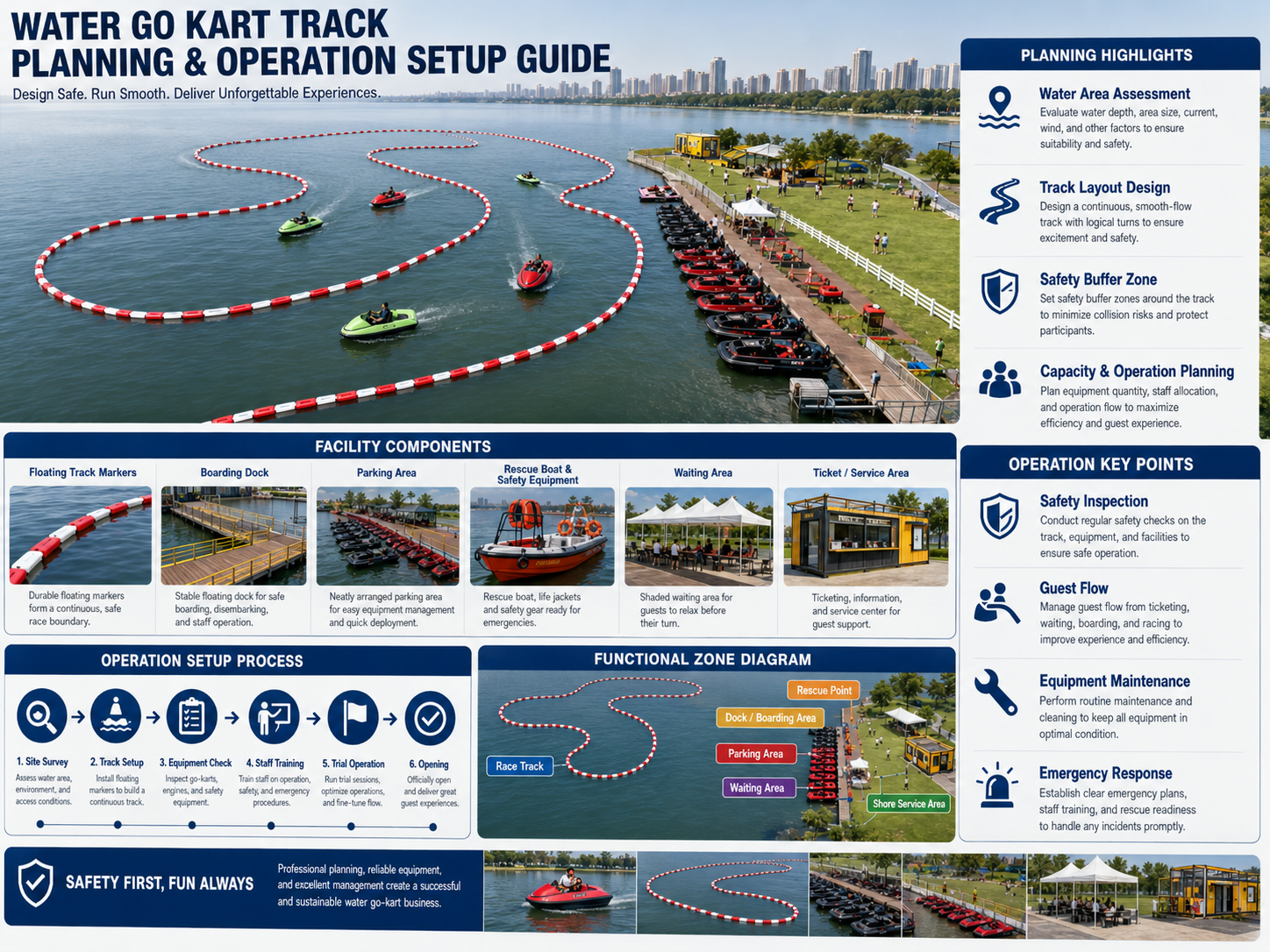
Unlike land-based tracks requiring expensive civil engineering, commercial floating water kart circuits can be deployed on natural or artificial water bodies in just a few days. This step-by-step engineering blueprint guides operators through 1.2m water depth assessments, 0.9mm inflatable PVC barrier layouts, elastic bungee shock anchoring systems, track geometry, and 5-minute dock turnaround SOPs.
One of the most powerful business attributes of commercial electric water karts is their spatial versatility. Unlike land-based karting tracks—which require acres of expensive asphalt paving, zoning permits, environmental drainage remediation, and extensive civil engineering—a commercial water kart circuit can be deployed on existing, underutilized water surfaces in a matter of days.
Whether you manage an expansive natural freshwater lake, a scenic coastal resort lagoon, an artificial municipal water park basin, or a large commercial wave pool during the off-season, proper track layout design is the difference between an average attraction and an extraordinary, high-turnover profit center.
This guide provides amusement operators, resort managers, and project engineers with a complete engineering roadmap for designing, anchoring, and operating a high-capacity floating water kart track.
Before laying out track geometry, your engineering team must evaluate three fundamental hydrological parameters:
Water Depth Profile: Minimum 1.2 m (3.94 ft) across all racing corridors to prevent impeller grounding, debris suction, and cavitation.
Current Velocity & Wave Amplitude: Maximum current under 1.5 knots (0.77 m/s) and wave height under 0.3 m (calm inland water ideal).
Shoreline Access & Power Infrastructure: 220V/380V commercial 3-phase power on the dock for fast charging, plus a smooth passenger boarding and life-jacket staging area.
A well-designed water kart track must balance high-speed excitement for drivers with safety and high operational throughput for the venue operator.
Key Circuit Design Principles:
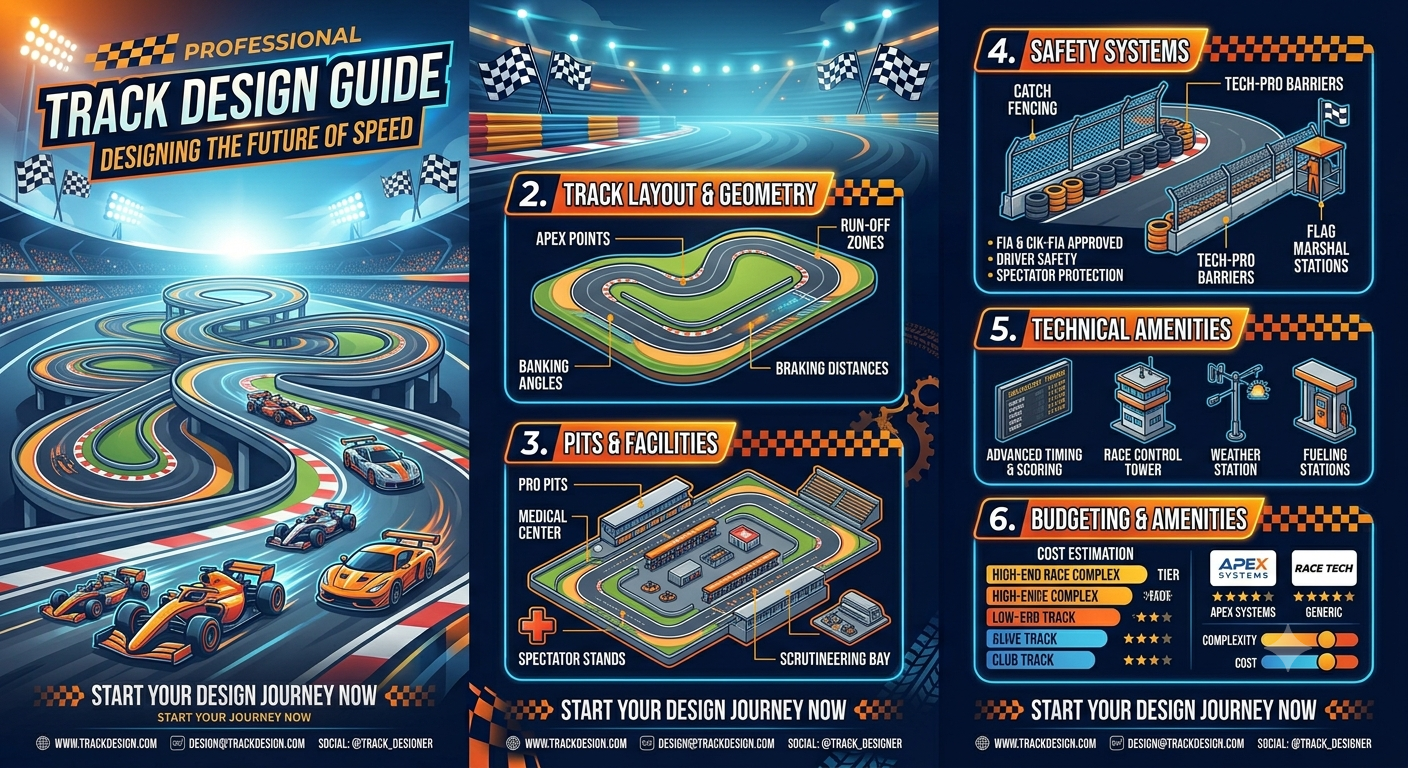
Corridor Width Dimensions: Main straights should be a minimum of 6.0 to 8.0 meters wide to allow dynamic two-wide overtaking. Chicanes and tight turns require 5.0 to 6.0 meters width to naturally meter vessel velocity without causing multi-kart logjams.
Buffer and Deceleration Zones: At the conclusion of the highest-speed straightaway (where karts hit 45–60 km/h), provide at least 15–20 meters of open runoff before entering the turn apex.
Pit Lane & Dock Approach: Design a dedicated, barrier-separated entry chute leading into the docking platform to prevent returning drivers from colliding with stationary boarding vessels.
Terrestrial go-karting uses steel barriers or tied tire walls. On the water, safety barriers must absorb kinetic energy, flex upon impact, remain perfectly buoyant, and resist persistent UV degradation.
Inflatable Barrier and Anchoring Specifications:
Material Composition: 0.9mm Commercial-Grade Tarpaulin PVC
Seam Construction: High-Frequency Thermal Fusion Welded
Connection System: Dual Stainless 316 D-Rings + Webbing Straps
Anchoring Line Material: Marine-Grade Elastic Bungee Shock Lines
Bed Anchoring Options: Helix Ground Screws (Sand) / Deadweight Concrete Blocks
Never anchor floating track barriers using rigid steel chains or non-elastic ropes directly to the lake bottom. When a kart strikes a barrier, rigid tethers transfer tremendous shock loads directly to the seabed anchors, causing them to drag or pull loose. Changfeng recommends commercial marine bungee shock tethers placed every 10–15 meters. When a barrier receives an impact, the elastic line stretches, absorbing the shock energy progressively and snapping the barrier back into exact alignment automatically.
Operational profitability depends directly on your Turnaround Time (TAT) between sessions. A 10-minute ride that requires 10 minutes of docking chaos reduces hourly revenue by 50%.
Optimized 5-Minute Docking Rotation SOP:
Minute 0:00 - 0:30: Fleet enters pit lane with safe engine kill.
Minute 0:30 - 1:30: Departing riders unbuckle and exit to staging bay.
Minute 1:30 - 3:00: Rapid battery swap (if below 30% SOC) and quick visual check.
Minute 3:00 - 4:30: New passenger boarding, seatbelt, and safety lanyard check.
Minute 4:30 - 5:00: Dock safety release and staggered track dispatch.
Dock Setup Infrastructure:
Modular Floating HDPE Docks: Non-slip, modular plastic floating cubes form a sturdy, dry staging platform level with the kart gunwales for effortless boarding.
Dedicated Quick-Swap Battery Station: Positioned directly on the dock, an insulated, covered charging rack holds reserve 5.5 kWh battery packs connected to industrial fast chargers. With Changfeng's 2-minute quick-release latches, battery changes are as fast as standard pit stops.
Designing a custom water circuit requires precise site calculation. Changfeng Kart offers comprehensive, end-to-end design and project deployment services for clients worldwide, including complimentary 3D CAD track layouts, complete hardware package delivery, and on-site operational safety training.
A highly viable commercial circuit for 4 to 6 karts can be built on as little as 1,800 to 2,500 square meters (approx. 0.45 to 0.6 acres). For larger fleets of 8 to 12 karts, 3,500 to 5,000 square meters is recommended. Because the entire track system floats, the elastic mooring lines automatically compensate for vertical water level fluctuations up to 2.5 meters.
Written by
Changfeng Kart Engineering Team
Senior Go-Kart Industry Consultants | 15+ Years Manufacturing Experience
Our engineering team has delivered 500+ go-kart projects across 50+ countries, specializing in commercial kart design, track engineering, and venue operations. Every article is reviewed by our technical directors to ensure accuracy and practical value for entertainment venue investors and operators.