
How Commercial Electric Water Go-Karts Maximize Water Park ROI: The Ultimate 2026 Operator Guide
Traditional pedal boats yield low margins while combustion jet skis suffer from excessive maintenance and fuel overheads. This article provides a comprehensive commercial analysis of 15kW/60km/h electric water go-karts, breaking down a 6-kart fleet daily revenue model, ultra-low operating expenses (OpEx), and a realistic 3-to-6-month payback blueprint for water park and waterfront resort operators.
The commercial water attractions market is experiencing a profound paradigm shift. For decades, water park operators, coastal beachfront resorts, and lakeside entertainment venues have relied on traditional offerings: manual pedal boats, tandem kayaks, stand-up paddleboards, and high-maintenance combustion jet skis.
While manual watercraft suffer from low repeat ride rates and minimal per-minute revenue, traditional jet skis present substantial operational barriers—excessive fuel overhead, noise pollution, engine maintenance downtime, high insurance liabilities, and restrictive environmental bans across natural water reserves.
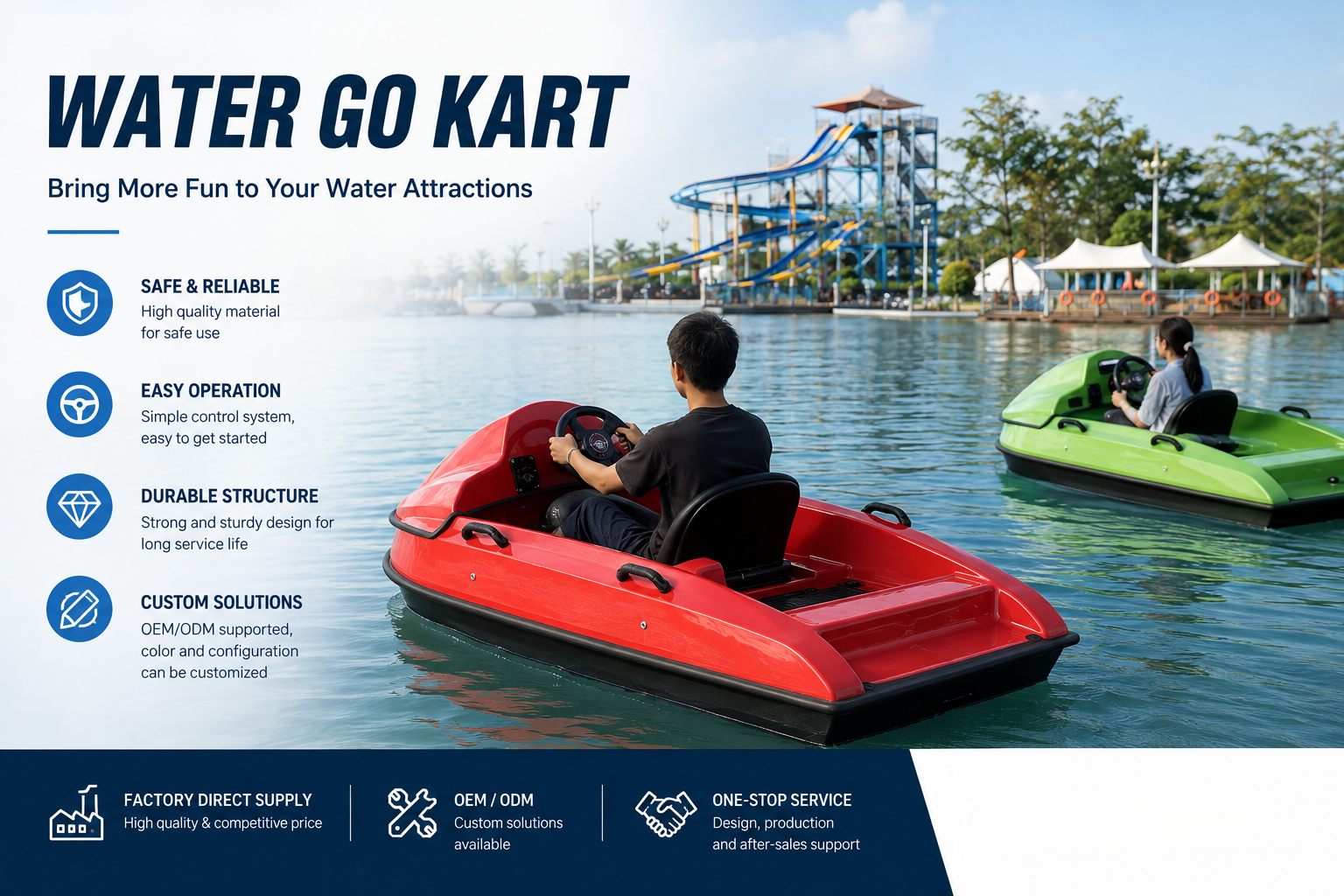
Enter the Commercial Electric Water Go-Kart (commonly engineered as high-performance Wave Runners or Aqua Karts). Powered by high-torque electric powertrains and enclosed in ultra-buoyant, impact-resistant ABS composite hulls, electric water go-karts merge the high-octane excitement of terrestrial motorsport racing with the safety and accessibility of modern amusement rides.
For theme park developers, leisure venue operators, and commercial investors, electric water karts represent the single highest return on investment (ROI) watercraft asset in 2026. This comprehensive guide outlines the operational mathematics, engineering advantages, and turnkey revenue models that drive rapid capital payback and sustained profitability.
The primary metric of success for any commercial leisure investment is the Velocity of Capital Recovery. To evaluate why commercial aqua karts outperform traditional aquatic rides, let us examine real-world operational figures based on a medium-sized fleet (6 units) deployed on a dedicated floating circuit.
Operational Scenario Model (6-Kart Commercial Circuit):
Fleet Size: 6 Commercial Electric Water Karts (Changfeng 15 kW Units)
Operating Hours: 8 Hours/Day (Peak Tourism Season)
Session Duration: 10 Minutes Ride + 5 Minutes Docking/Disembarking (4 Cycles/Hour)
Ticket Price Per Seat: $25.00 – $35.00 USD (Average: $30.00 USD)
Fleet Utilization Rate: 65% (Conservative Average)
Revenue & Cash Flow Calculation:
Sessions per Day per Kart = 8 hours 4 sessions/hour 65% = 20.8 paid sessions
Daily Gross Revenue per Kart = 20.8 * $30.00 = $624.00 USD
Daily Gross Revenue (6-Kart Fleet) = 6 * $624.00 = $3,744.00 USD
Monthly Gross Revenue (30 Days) = $112,320.00 USD
Operational Expenditure (OpEx) Breakdown:
Electricity & Recharging: Each 5.5 kWh battery pack costs approximately $0.80 to $1.20 to fully charge based on commercial electricity rates ($0.15–$0.20/kWh). A full day of multi-kart operation consumes less than $25 in total electricity.
Staffing Requirements: A standard 6-kart floating circuit requires only 2 operators (1 dock marshall/safety controller and 1 ticketing/briefing staff member).
Routine Maintenance: Unlike 2-stroke/4-stroke combustion engines that require oil changes, spark plugs, carb cleanouts, and impeller replacements, brushless electric motors require virtually zero routine powertrain maintenance outside of periodic seal inspections.
Net Profit Margin: Operating profit margins typically hover between 82% and 88%, allowing project owners to fully amortize equipment acquisition and track setup within 90 to 150 operating days.
When evaluating commercial watercraft, fleet reliability is paramount. A vessel stuck at the dock generates zero revenue while incurring maintenance labor costs.
Key Technical Specifications of Changfeng Commercial Aqua Karts:
Peak Motor Output: 15 kW High-Efficiency Pure Electric Motor
Top Speed: 45–60 km/h (Configurable via dual-speed master switch)
Battery Pack: 5.5 kWh (74.4 Ah) Lithium Pack with Intelligent BMS
Battery Cycle Life: >= 800 Full Cycles at >80% Capacity Retention
Ingress Protection: Full System IP67 Waterproofing (Submersible Motor & Electronics)
Hull Construction: High-Density, UV-Stabilized Polymeric ABS Composite
Vessel Dimensions: 240 cm (L) 95 cm (W) 80 cm (H)
Kerb Weight & Payload: 104 kg (Net with Battery) | 150 kg (Max Payload)
Electric brushless motors deliver 100% torque instantly from 0 RPM. On the water, this translates into immediate hull planing, responsive steering response around tight buoys, and dynamic acceleration out of corners. Drivers experience the visceral thrill of an open-wheel kart race without exhaust fumes or deafening engine roar.
Safety and insurance compliance are fundamental to family entertainment centers. Changfeng water go-karts integrate a dual-speed governor system:
Novice / Family Mode (20–25 km/h): Restricts peak current for younger riders, beginners, or congested resort lagoons.
Pro / Racing Mode (45–60 km/h): Unlocks full 15 kW motor capability for adrenaline seekers, corporate team building, and competitive time-trial attractions.
Commercial recreation demands fail-safe engineering. In public operations, collisions, aggressive maneuvers, and varying passenger weights are constant variables.
Closed-Cell Buoyancy Core: The hull features internal closed-cell polyurethane foam cores strategically positioned within the outer ABS shell. Even in the unlikely event of outer shell puncture, the kart maintains positive buoyancy and remains completely unsinkable.
Impact-Absorbing ABS Composite: Unlike traditional fiberglass (FRP), which tends to crack, splinter, and require skilled gelcoat repairs upon impact, high-density ABS possesses elastic deformation properties. It flexes under dynamic barrier strikes and recovers its shape without structural fatigue.
Ultra-Low Center of Gravity (CoG): By mounting the heavy lithium battery array directly along the lowest centerline keel, the craft exhibits extraordinary self-righting moments. Capsize risk under standard track racing conditions is virtually eliminated.
One of the greatest competitive advantages of the electric water kart is venue adaptability. A complete commercial attraction can be established in as little as 48 hours on virtually any body of water meeting minimum criteria.
Site Requirements:
Water Depth: Minimum 1.2 meters (3.94 feet) depth to ensure free impeller clearance and zero grounding risk.
Surface Conditions: Calm water surfaces—artificial lakes, commercial lagoons, dedicated water park wave pool off-seasons, resort bays, or large commercial swimming pools.
Track Configuration: Interlocking high-durability floating PVC inflatable safety barriers anchor to the lakebed or shoreline, creating customizable chicanes, straightaways, and hairpin turns.
Procuring commercial amusement equipment through trading intermediaries introduces substantial markup, delayed parts fulfillment, and fragmented warranty support. Sourcing directly from Changfeng Kart delivers decisive strategic advantages:
15+ Years of Dedicated Manufacturing: Over 500 track installations across 50+ countries worldwide.
Factory-Direct Pricing: Cut out distributor markups to maximize your project capital efficiency.
Turnkey Customization (OEM/ODM): Custom hull RAL color-matching, corporate branding, custom LED under-glow lighting packages, and bespoke telemetry integrations.
Guaranteed Spare Parts Pipeline: Comprehensive inventory of spare battery packs, IP67 controllers, replacement impellers, and modular hull panels dispatched globally via express logistics.
Under typical commercial operating conditions (mixed speed profiles on a closed circuit), each 5.5 kWh lithium battery pack provides 60 to 90 minutes of continuous run time. By utilizing our modular quick-swap battery system, operators maintain a continuous rotation: while one battery operates on the water, a secondary pack recharges on the dock, enabling 12+ hours of uninterrupted daily venue operation.
Routine maintenance is minimal:
Daily: Rinse hull with clean fresh water (especially in saltwater/resort environments) and perform a visual check of the steering linkages.
Weekly: Inspect motor shaft seal and battery terminal gaskets.
Monthly: Verify battery cell balancing via the integrated smart BMS digital readout.
Changfeng water go-karts utilize marine-grade 316 stainless steel hardware, anodized aluminum structural mounts, and hermetically sealed IP67 electrical components engineered specifically for high-salinity coastal resort operations.
Commercial electric water go-karts represent the convergence of sustainability, low operational overhead, and high-margin thrill entertainment. Whether you are expanding an existing water park, developing a luxury resort waterfront, or launching a standalone floating entertainment venue, Changfeng Kart provides the engineering excellence and turnkey support needed to guarantee commercial success.
Written by
Changfeng Kart Engineering Team
Senior Go-Kart Industry Consultants | 15+ Years Manufacturing Experience
Our engineering team has delivered 500+ go-kart projects across 50+ countries, specializing in commercial kart design, track engineering, and venue operations. Every article is reviewed by our technical directors to ensure accuracy and practical value for entertainment venue investors and operators.